
Backups Are Not Enough: Why Testing Matters More Than You Think
Having backups isn’t the same as being protected. This post explains why backup testing, verification, and recovery planning are essential for real business continuity in 2026.
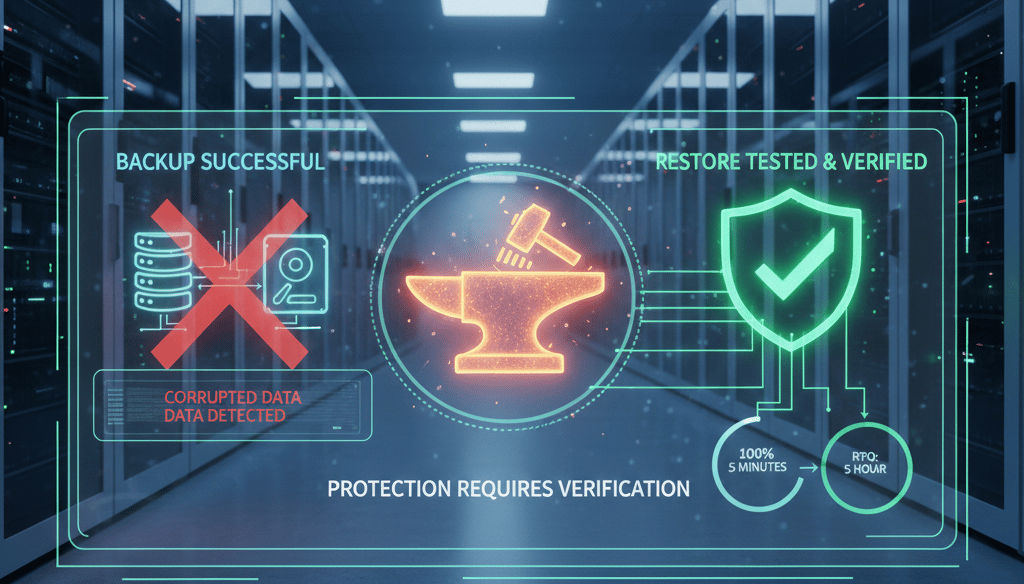
Many businesses feel confident once backups are in place. Files are copied. Systems are scheduled. Notifications say “completed successfully.” It creates a sense of security.
But in 2026, having backups is not the same as being protected.
Backups Create Confidence — Testing Creates Assurance
A backup only proves that data was copied somewhere. It does not prove that:
The data is complete
The files are not corrupted
The backup can be restored quickly
The system will function properly after recovery
The only way to know a backup works is to test it.
Most Backup Failures Aren’t Obvious
Backup failures are rarely dramatic. They are quiet:
Storage fills up gradually
Backup jobs skip files without clear alerts
Encryption keys are missing
Recovery credentials are outdated
Cloud backups are incomplete
These issues often go unnoticed until a restore is urgently needed.
And by then, it’s too late.
Ransomware Changes the Equation
Modern ransomware doesn’t just encrypt production systems. It actively searches for and targets backups. If backups are connected to the network or not properly segmented, they can be encrypted as well.
Without isolated and verified backups, recovery options become limited and expensive.
Recovery Time Matters
Even if backups are technically available, the real question is:
How long will it take to restore operations?
Recovery planning should answer:
How quickly can critical systems be restored?
What data can be recovered, and how recent is it?
Who is responsible for initiating recovery?
Has the process been practiced?
Backups without a recovery plan create uncertainty during a crisis.
Protection Requires Verification
A reliable backup strategy includes:
Regular backup monitoring
Routine restore testing
Offsite or immutable copies
Clear recovery documentation
Defined recovery time objectives
Testing transforms backups from a checkbox into a safeguard.
Confidence Should Be Measured, Not Assumed
Most businesses only discover weaknesses in their backup strategy during an emergency. By then, stress and downtime amplify the consequences.
In modern IT environments, protection is not about simply having backups — it is about knowing they will work when needed.
At FortiArc, backup verification is not optional. It is part of maintaining stability before disruption occurs.
Because the worst time to test a backup is when your business is already offline.


Area of Expertise
Cybersecurity
Managed IT Services
Hardware and License Procurement