Ransomware & the True Cost of a Breach
Cyber threats are evolving faster than ever. This post breaks down the biggest ransomware trends and what they mean for your business.
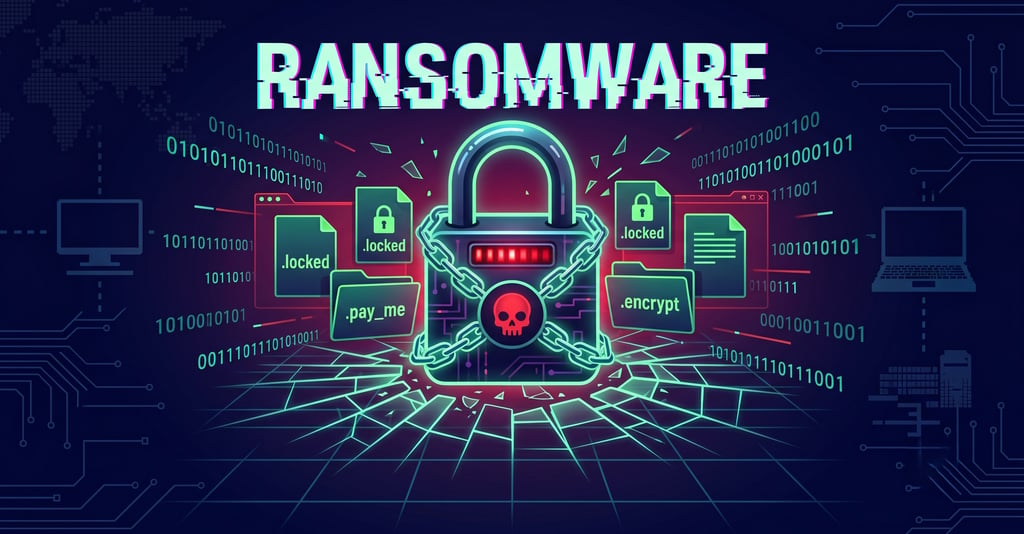
Ransomware has evolved from an opportunistic tactic into a global criminal industry. Powered by the Ransomware-as-a-Service model, criminal networks now operate with the structure and efficiency of legitimate software businesses — complete with affiliate programs, customer support desks, and revenue-sharing models that enable even low-skill attackers to deploy sophisticated campaigns against organizations of any size.
The speed and scope of modern attacks have fundamentally changed the defensive calculus. Attackers now move from initial network access to full encryption in under four hours, and in 76% of incidents, data is exfiltrated before encryption begins — meaning every ransomware event is simultaneously a data breach. The number of claimed victims jumped 58% in 2025, with over 7,500 organizations publicly exposed on attacker-operated leak sites. The real number of incidents is believed to be substantially higher, as many organizations choose not to disclose breaches publicly.
THE FINANCIAL IMPACT
The ransom payment is consistently the smallest component of a ransomware incident's true cost. IBM's 2025 Cost of a Data Breach Report places the average total incident cost at $4.4 million — more than 38 times the median ransom demand of $115,000 reported by Verizon. Beyond the demand itself, organizations face forensic investigation fees, legal and regulatory costs, system rebuilding expenses, lost revenue during operational downtime, and the long-term erosion of customer and partner trust. Recovery costs alone, excluding any ransom payment, averaged $1.53 million in 2025 according to Sophos, and the total financial impact per incident ranges from $1.8 million to $5 million when all factors are accounted for.
Paying the ransom offers no guarantee of resolution. Only 46% of victims who paid actually recovered their data successfully, and 80% experienced a subsequent attack shortly after demonstrating their willingness to pay. In 2025, 64% of victims refused to pay ransoms — reflecting improved recovery capabilities and increasing law enforcement guidance — and organizations with tested, immutable backup systems were the most likely to restore operations without engaging with attackers at all.
WHO IS BEING TARGETED
While no sector is immune, healthcare has emerged as one of the most severely impacted industries — 54% of healthcare organizations reported ransomware attacks by mid-2025, with an average breach cost of $7.42 million (IBM). Government bodies experienced a 65% year-over-year increase in incidents in H1 2025, and financial services firms face both direct breach costs and significant regulatory consequences. Manufacturing and education sectors have also seen sustained, disruptive attacks over the past two years.
Small and mid-sized businesses have become ransomware target number one. Ransomware accounted for 88% of all SMB breaches tracked in 2025, driven by the reality that SMBs typically lack dedicated security teams, maintain inconsistent backup practices, and operate on tighter margins that make recovery more difficult. A Mastercard global study of over 5,000 SMB owners found that nearly one in five businesses that experienced a cyberattack filed for bankruptcy or closed permanently. Of those that survived, 80% spent significant time rebuilding trust with customers and partners — an ongoing cost that extends well beyond the immediate incident.
HOW ATTACKERS GET IN
Compromised credentials now account for 48% of ransomware attacks, making identity-based intrusion the single most common entry vector as of Q3 2025 (HIPAA Journal). Attackers purchase stolen usernames and passwords from dark web marketplaces, exploit exposed remote access portals, and leverage previously breached accounts to gain footholds in target networks. Phishing and social engineering remain significant vectors, with AI-generated emails making fraudulent communications increasingly difficult for employees to identify. Unpatched vulnerabilities, exposed Remote Desktop Protocol ports, and supply chain compromises through trusted third-party vendors round out the primary attack surface.
Once inside, attackers move quietly. The global median dwell time was 14 days in 2025 (Mandiant M-Trends 2026), meaning attackers spent nearly two weeks mapping networks, elevating privileges, exfiltrating data, and destroying backups before triggering encryption. Organizations that detected intrusions through internal monitoring identified threats in approximately 9 days on average; those relying on external notification took a median of 25 days — nearly three times longer. That gap is decisive in determining whether an incident is contained or catastrophic.
WHAT SEPARATES ORGANIZATIONS THAT RECOVER
The organizations that fare best against ransomware share three characteristics: they monitor continuously, they test their recovery capabilities before they need them, and they operate under an assumed-breach model — designing defenses as if the attacker may already be inside the network. Sophos's 2025 data found that 56% of organizations with mature recovery capabilities restored operations within one week of a ransomware attack, up from just 33% the prior year. The difference is not the tools deployed but whether those tools are actively monitored and whether recovery plans have been tested and pre-authorized.
For most small and mid-sized businesses, building this capability internally is neither financially feasible nor operationally practical. A Managed Security Service Provider bridges that gap — delivering 24/7 monitoring, behavioral threat detection, incident response, and recovery support at a fraction of the cost of an in-house security operations center.
Area of Expertise
Cybersecurity
Managed IT Services
Hardware and License Procurement