
Why Small Businesses Are Targeted More Than Enterprises in 2026
Small businesses are no longer overlooked by cybercriminals. In 2026, attackers actively target smaller organizations because they’re often easier to breach. This post explains why the “we’re too small” mindset is risky—and what it really means for your business.
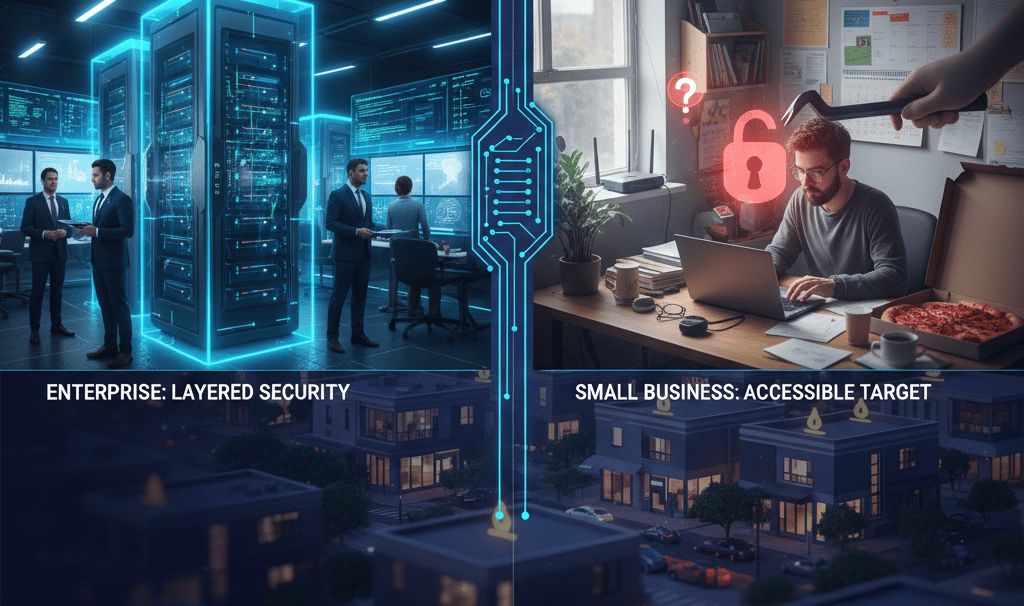
Many small business owners assume cybercriminals only go after large corporations. It feels logical—big companies have more data, more money, and more visibility. But in 2026, that assumption is one of the most common and costly misconceptions in cybersecurity.
The reality is that small and mid‑sized businesses are often the preferred targets.
Smaller Targets Are Easier Targets
Large enterprises invest heavily in layered security, internal IT teams, compliance programs, and dedicated security operations. Small businesses, on the other hand, often operate with limited resources and reactive IT support.
Attackers look for efficiency. They scan for weak passwords, unpatched systems, exposed remote access tools, and outdated firewalls. These vulnerabilities are more common in smaller environments—not because business owners are careless, but because they are busy running their operations.
Cybercrime today is automated, not personal.
Volume Is the Strategy
Modern attackers do not need to break into one massive corporation. Instead, they launch automated campaigns targeting thousands of smaller organizations at once. Phishing emails, credential‑stuffing attacks, and ransomware deployments are designed to cast a wide net.
If even a small percentage succeed, the attack is profitable.
For criminals, it’s a numbers game.
Small Businesses Often Have Valuable Data
Even smaller organizations hold sensitive information:
Patient records
Payment information
Employee data
Vendor credentials
Access to larger partner networks
In many cases, small businesses also serve as entry points into larger organizations through shared systems or vendor relationships.
Data value is not determined by company size.
The “Too Small” Mindset Creates Gaps
When a business believes it is unlikely to be targeted, security investments are often delayed. Multi‑factor authentication may not be enforced. Backups may not be regularly tested. Updates may be postponed to avoid disruption.
Unfortunately, attackers rely on this mindset.
Most cyber incidents begin with something small: a reused password, a missed patch, or a single employee clicking a convincing email.
Security Is About Probability, Not Popularity
Being targeted is rarely about fame or visibility. It is about exposure. If systems are reachable, credentials are weak, or monitoring is limited, the risk increases regardless of company size.
The question is not whether a business is large enough to be targeted. It is whether it is protected enough to deter opportunistic attacks.
Prevention Is More Affordable Than Recovery
For small businesses, the financial and operational impact of a breach can be severe. Downtime, recovery costs, reputational damage, and potential regulatory issues can take months to resolve.
Proactive monitoring, layered security controls, verified backups, and structured IT management significantly reduce that risk.
In 2026, cybersecurity is no longer an enterprise concern—it is a business necessity.
At FortiArc, we focus on helping small and mid‑sized organizations build practical, proactive defenses that reduce exposure without disrupting daily operations.
Because being small does not make you invisible—it often makes you accessible.


Area of Expertise
Cybersecurity
Managed IT Services
Hardware and License Procurement